AI · 2026-10-14
If home AI assistants become commonplace, what should users check?
Cerebras CEO Andrew Feldman predicts that personal AI assistants could become as common as household appliances, with some work handled locally and some in the cloud.
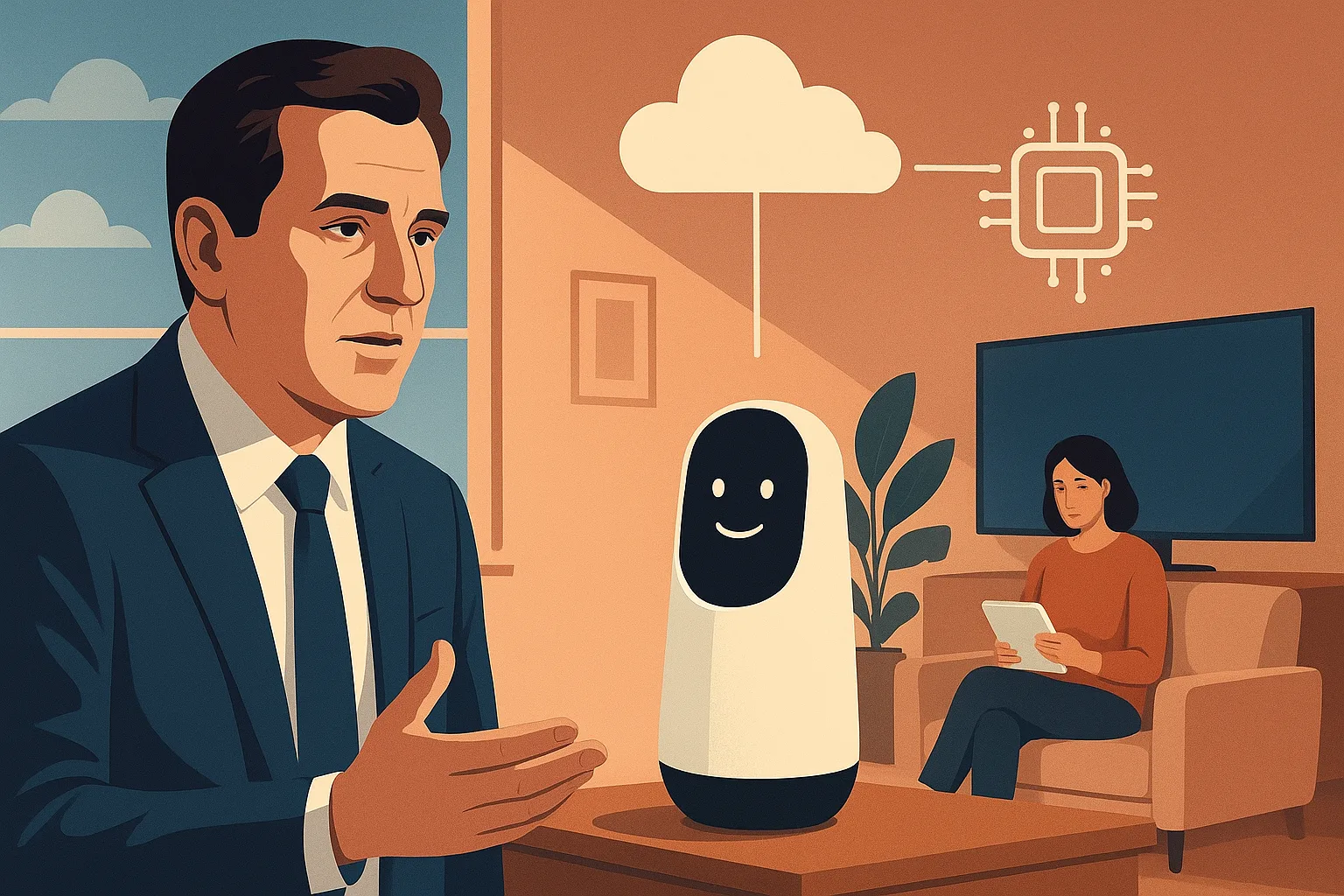
Cerebras CEO Andrew Feldman predicts that personal AI assistants may become as commonplace as household appliances. The supplied excerpt describes a possible arrangement in which some tasks run on local devices and others in the cloud. That is a forecast, not evidence that widespread adoption is already happening or that a particular design is settled.
If this kind of assistant becomes part of everyday home life, convenience will be only one consideration. Users may also want to know which tasks are processed on a device and which depend on cloud services. Those choices can matter for privacy expectations, reliance on an internet connection, and what the assistant can do when connectivity is unavailable. But the excerpt does not say what information would be sent or stored, whether users could choose where processing happens, or how a system would behave offline. No specific privacy or reliability advantage can be inferred from it.
A practical way to assess such a product would be to begin with the intended use. Someone seeking help with recurring household tasks may have different needs from someone who wants an assistant to organize information. Before adopting one, users could look for clear explanations of local versus cloud processing, controls over those settings, and a description of what functions remain available without a connection. These are useful questions raised by the proposed model, not features confirmed in the supplied material.
For businesses, the analogy to an appliance also invites a question about expectations: will people treat an assistant as a simple utility, or as a service that needs ongoing setup and oversight? The excerpt does not establish how these assistants would be priced, maintained, or supported, so those are open issues rather than conclusions.
Limitations and uncertainty: This analysis relies only on the supplied headline and excerpt, not the full article. They provide no timeline, evidence for the prediction, cost estimates, product details, or account of data-handling practices. It is therefore not possible to say that household assistants are about to become universal, or to determine whether a local-and-cloud arrangement would be preferable in practice. The useful takeaway is to treat the prediction as a scenario and evaluate concrete products by their actual capabilities and disclosed data practices.
← Back to articlesIf this kind of assistant becomes part of everyday home life, convenience will be only one consideration. Users may also want to know which tasks are processed on a device and which depend on cloud services. Those choices can matter for privacy expectations, reliance on an internet connection, and what the assistant can do when connectivity is unavailable. But the excerpt does not say what information would be sent or stored, whether users could choose where processing happens, or how a system would behave offline. No specific privacy or reliability advantage can be inferred from it.
A practical way to assess such a product would be to begin with the intended use. Someone seeking help with recurring household tasks may have different needs from someone who wants an assistant to organize information. Before adopting one, users could look for clear explanations of local versus cloud processing, controls over those settings, and a description of what functions remain available without a connection. These are useful questions raised by the proposed model, not features confirmed in the supplied material.
For businesses, the analogy to an appliance also invites a question about expectations: will people treat an assistant as a simple utility, or as a service that needs ongoing setup and oversight? The excerpt does not establish how these assistants would be priced, maintained, or supported, so those are open issues rather than conclusions.
Limitations and uncertainty: This analysis relies only on the supplied headline and excerpt, not the full article. They provide no timeline, evidence for the prediction, cost estimates, product details, or account of data-handling practices. It is therefore not possible to say that household assistants are about to become universal, or to determine whether a local-and-cloud arrangement would be preferable in practice. The useful takeaway is to treat the prediction as a scenario and evaluate concrete products by their actual capabilities and disclosed data practices.